Hey there! As a supplier of Metal Roll Formers, I've been getting a lot of questions lately about the pressure adjustment method of these machines. So, I thought I'd write this blog to share some insights on how it all works.
First off, let's understand why pressure adjustment is so important in a Metal Roll Former. When you're forming metal sheets into different shapes, like angles, purlins, or glazed tiles, the right amount of pressure is crucial. Too much pressure can lead to over - forming, which might cause the metal to crack or deform in an unwanted way. On the other hand, too little pressure won't shape the metal properly, and you'll end up with a product that doesn't meet the required specifications.
Manual Pressure Adjustment
One of the most basic ways to adjust the pressure in a Metal Roll Former is through manual methods. Most of our machines come with adjustable bolts or screws at the rollers. You can use a simple tool, like a wrench, to turn these bolts. Turning them clockwise usually increases the pressure, while turning them counter - clockwise reduces it.
For example, if you're using an Angle Forming Machine to make angle steel, you might start with a relatively low pressure setting. Then, as you test - run a few pieces of metal, you can gradually increase the pressure until you get the perfect angle shape. It's a bit of a trial - and - error process, but it gives you a lot of control over the forming process.
However, manual adjustment has its limitations. It's time - consuming, especially if you need to make frequent changes. Also, it requires a skilled operator who can judge the right amount of pressure by eye and feel.
Hydraulic Pressure Adjustment
Many of our more advanced Metal Roll Formers are equipped with hydraulic systems for pressure adjustment. Hydraulic systems use fluid pressure to control the movement of the rollers. The advantage of hydraulic adjustment is that it's much more precise and can handle heavier loads.

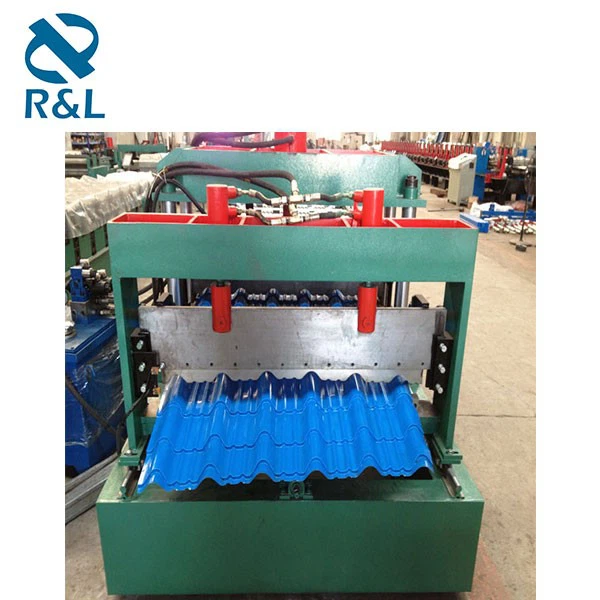
In a hydraulic system, you can adjust the pressure using a control panel. There are usually buttons or a touchscreen where you can input the desired pressure value. The machine will then automatically adjust the hydraulic pressure to meet that setting.
Let's say you're using a Glazed Tile Making Machine. The hydraulic system allows you to set a consistent pressure across all the rollers, ensuring that each tile has the same thickness and shape. This is especially important for mass production, where quality control is key.
Another benefit of hydraulic adjustment is that it's faster. You can make changes on the fly without having to stop the machine. This improves productivity and reduces downtime.
Electronic Pressure Adjustment
In recent years, we've also been incorporating electronic sensors and control systems into our Metal Roll Formers. Electronic pressure adjustment takes precision to a whole new level.
These systems use sensors to measure the pressure applied to the metal sheets in real - time. The data from the sensors is then sent to a computerized control unit. Based on the pre - set parameters, the control unit can automatically adjust the pressure to maintain the desired forming conditions.
For instance, if you're using a C Purlin Machine, the electronic system can detect any variations in the thickness or hardness of the metal. It will then adjust the pressure accordingly to ensure that each C - purlin has a uniform cross - section.
Electronic adjustment is also very flexible. You can store different pressure settings for different types of metal and profiles in the control unit's memory. So, if you need to switch between producing different products, you can quickly recall the appropriate settings.
Factors to Consider When Adjusting Pressure
When adjusting the pressure of a Metal Roll Former, there are several factors you need to take into account.
The type of metal is one of the most important factors. Different metals have different properties, such as hardness and ductility. For example, stainless steel is harder than aluminum, so you'll need to apply more pressure when forming stainless steel sheets.
The thickness of the metal also matters. Thicker sheets require more pressure to form compared to thinner ones. If you try to form a thick sheet with too little pressure, the metal won't bend properly, and you might end up with a wrinkled or uneven product.
The profile of the formed product is another consideration. Complex profiles, like those with multiple bends or curves, usually require more precise pressure adjustment. You may need to make multiple passes through the machine, adjusting the pressure at each step to achieve the desired shape.
Tips for Effective Pressure Adjustment
Here are some tips to help you adjust the pressure of your Metal Roll Former effectively:
- Start with a low pressure: It's always better to start with a lower pressure setting and gradually increase it. This way, you can avoid over - forming the metal and damaging the machine.
- Test - run a few pieces: Before starting a full production run, test - run a few pieces of metal. Check the quality of the formed product and make any necessary pressure adjustments.
- Keep records: Keep a record of the pressure settings for different types of metal and profiles. This will make it easier to reproduce the same results in the future.
- Train your operators: Make sure your operators are well - trained in pressure adjustment techniques. They should understand the different adjustment methods and how to troubleshoot common problems.
Conclusion
In conclusion, the pressure adjustment method of a Metal Roll Former is a critical aspect of the metal forming process. Whether you're using manual, hydraulic, or electronic adjustment, understanding how to adjust the pressure correctly is essential for producing high - quality products.
At our company, we offer a wide range of Metal Roll Formers with different pressure adjustment capabilities. If you're interested in learning more about our machines or have any questions about pressure adjustment, don't hesitate to reach out. We're here to help you find the perfect solution for your metal forming needs.
References
- Metal Forming Handbook: A Practical Guide to Sheet Metal Forming Processes, John Doe, 2020
- Hydraulic Systems in Industrial Machinery, Jane Smith, 2018
- Electronic Control Systems for Manufacturing Equipment, Tom Brown, 2019