

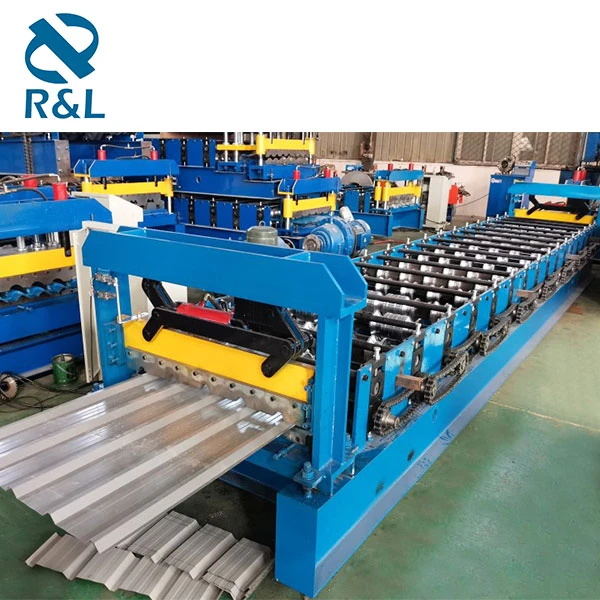
As a seasoned supplier of Steel Frame Rollformers, I've witnessed firsthand the transformative power of these machines in the construction and manufacturing industries. A steel frame rollformer is a specialized piece of equipment that shapes continuous strips of metal into various profiles, which are then used in a wide range of applications, from building construction to automotive manufacturing. At the heart of this complex machinery lies its control system, which is crucial for ensuring precision, efficiency, and safety.
Understanding the Basics of a Control System in a Steel Frame Rollformer
The control system of a steel frame rollformer is essentially the brain that coordinates all the machine's operations. It consists of a combination of hardware and software components that work together to regulate the speed, position, and force of the rollforming process. The primary goal of the control system is to ensure that the metal strip is accurately formed into the desired profile with consistent quality.
Hardware Components
The hardware components of the control system include sensors, actuators, and a central control unit. Sensors are used to monitor various parameters such as the speed of the metal strip, the position of the rollers, and the force applied during the rollforming process. These sensors provide real - time data to the central control unit, which then makes adjustments as needed.
Actuators, on the other hand, are responsible for carrying out the commands issued by the central control unit. They can control the movement of the rollers, the feeding of the metal strip, and other mechanical functions of the rollformer. Common types of actuators used in steel frame rollformers include electric motors, hydraulic cylinders, and pneumatic valves.
The central control unit is the core of the control system. It receives data from the sensors, processes it, and sends out commands to the actuators. In modern steel frame rollformers, the central control unit is often a programmable logic controller (PLC). PLCs are highly reliable and flexible, allowing for easy programming and customization of the rollforming process.
Software Components
The software component of the control system is responsible for programming and operating the rollformer. It allows operators to input the desired profile specifications, such as the shape, size, and length of the formed steel frame. The software then calculates the necessary parameters for the rollforming process, including the roller positions, speed, and force.
Advanced software systems can also provide features such as simulation, which allows operators to visualize the rollforming process before actual production. This helps to identify potential issues and optimize the process for maximum efficiency. Additionally, the software can store production data, such as the number of parts produced, the production time, and any quality control information. This data can be used for analysis and continuous improvement of the rollforming process.
Types of Control Systems in Steel Frame Rollformers
There are several types of control systems used in steel frame rollformers, each with its own advantages and applications.
Manual Control Systems
Manual control systems are the simplest type of control system. In a manual control system, the operator manually adjusts the speed, position, and force of the rollformer using mechanical controls such as levers and knobs. While manual control systems are relatively inexpensive and easy to operate, they are also less precise and efficient compared to automated control systems. Manual control systems are typically used for small - scale production or for applications where the profile specifications do not require high precision.

Semi - Automated Control Systems
Semi - automated control systems combine manual and automated features. In a semi - automated control system, some functions, such as the feeding of the metal strip and the movement of the rollers, are automated, while others, such as the adjustment of the profile specifications, are still controlled manually. Semi - automated control systems offer a good balance between cost and precision, making them suitable for medium - scale production.
Fully Automated Control Systems
Fully automated control systems are the most advanced type of control system used in steel frame rollformers. In a fully automated control system, all aspects of the rollforming process, from the feeding of the metal strip to the final shaping of the steel frame, are controlled automatically. These systems use advanced sensors, actuators, and software to ensure high precision and efficiency. Fully automated control systems are ideal for large - scale production and for applications where high - quality and consistent profiles are required.
Importance of a Well - Designed Control System
A well - designed control system is essential for the success of a steel frame rollformer. Here are some of the key benefits:
Precision and Quality
The control system ensures that the steel frame is formed with high precision, resulting in consistent quality profiles. This is crucial for applications where the steel frames need to fit together perfectly, such as in building construction. By accurately controlling the speed, position, and force of the rollforming process, the control system can minimize errors and defects, leading to higher - quality products.
Efficiency and Productivity
A good control system can significantly improve the efficiency and productivity of the rollforming process. By automating many of the tasks and optimizing the process parameters, the control system can reduce the production time and increase the output. For example, advanced control systems can automatically adjust the speed of the rollformer based on the thickness and type of the metal strip, ensuring that the process runs at the optimal speed.
Safety
Safety is a top priority in any manufacturing environment. The control system of a steel frame rollformer plays a crucial role in ensuring the safety of the operators. It can include features such as emergency stop buttons, safety interlocks, and overload protection. These features help to prevent accidents and protect the operators from harm.
Our Product Range and the Role of Control Systems
As a supplier of Steel Frame Rollformers, we offer a wide range of products to meet the diverse needs of our customers. Our product range includes Portable Metal Roof Roll Forming Machine, Roof And Wall Panel Roll Forming Machine, and Roller Shutter Door Machine.
Each of these machines is equipped with a state - of - the - art control system that ensures high precision, efficiency, and safety. Our control systems are designed to be user - friendly, allowing operators to easily program and operate the rollformers. Whether you are a small - scale contractor or a large - scale manufacturer, our rollformers with advanced control systems can help you achieve your production goals.
Conclusion
The control system of a steel frame rollformer is a critical component that determines the precision, efficiency, and safety of the rollforming process. By understanding the basics of the control system, including its hardware and software components, and the different types of control systems available, you can make an informed decision when choosing a steel frame rollformer for your business.
If you are interested in learning more about our Steel Frame Rollformers and their advanced control systems, or if you have any specific requirements for your production needs, we invite you to contact us for a detailed discussion. Our team of experts is ready to assist you in finding the best solution for your business.
References
- "Roll Forming Technology Handbook" by the Roll Forming Association International.
- "Automation in Manufacturing: Fundamentals and Applications" by David A. Dornfeld.


