

As a leading supplier of steel roll forming machines, I've been deeply involved in the industry for years. One question that often comes up in discussions with clients and industry peers is: What is the response time of the control system in a steel roll forming machine? In this blog, I'll explore this topic in detail, sharing insights based on my experience and knowledge.
Understanding the Control System in Steel Roll Forming Machines
Before delving into the response time, it's essential to understand the role of the control system in a steel roll forming machine. The control system is the brain of the machine, responsible for coordinating various components and ensuring smooth and accurate operation. It manages functions such as speed control, length measurement, and cut-off operations.
Modern steel roll forming machines are equipped with advanced control systems that use programmable logic controllers (PLCs) and human-machine interfaces (HMIs). These systems allow operators to set parameters, monitor the machine's performance, and make adjustments as needed. The control system also plays a crucial role in ensuring the quality and consistency of the formed steel products.
What is Response Time?
In the context of a steel roll forming machine's control system, response time refers to the time it takes for the system to detect a change in input and generate an appropriate output. This could be a change in speed, length, or any other parameter that affects the machine's operation. A fast response time is crucial for maintaining accuracy and efficiency in the roll forming process.
For example, when a cut-off operation is required, the control system needs to detect the desired length of the formed steel and send a signal to the cutting mechanism. The shorter the time between detecting the length and initiating the cut, the more accurate the final product will be. Similarly, in speed control, a quick response time ensures that the machine can adjust its speed promptly to match the production requirements.
Factors Affecting Response Time
Several factors can influence the response time of a steel roll forming machine's control system. Understanding these factors is essential for optimizing the machine's performance.
1. Hardware Quality
The quality of the hardware components used in the control system, such as the PLC, sensors, and actuators, plays a significant role in determining the response time. High-quality components are designed to operate with minimal latency, ensuring a faster and more reliable response. For instance, a high-speed PLC can process input signals more quickly, reducing the overall response time.

2. Software Design
The software program running on the control system also affects the response time. A well-designed software algorithm can efficiently process input data and generate output signals in a timely manner. It should be optimized for the specific requirements of the roll forming process, taking into account factors such as speed, accuracy, and safety.
3. Communication Protocols
The communication protocols used between different components of the control system can impact the response time. Fast and reliable communication protocols, such as Ethernet or Profibus, can reduce the time it takes for data to be transmitted between the PLC, sensors, and actuators. This ensures that the control system can respond quickly to changes in input.
4. System Load
The load on the control system, including the number of sensors and actuators connected and the complexity of the control tasks, can affect the response time. A heavily loaded system may take longer to process input signals and generate output, leading to a slower response. Therefore, it's important to design the control system to handle the expected load efficiently.
Measuring and Improving Response Time
Measuring the response time of a steel roll forming machine's control system is crucial for evaluating its performance and identifying areas for improvement. One common method is to use a high-speed data acquisition system to record the time between input and output signals. This data can then be analyzed to determine the average response time and any variations.
To improve the response time, several strategies can be implemented. Upgrading the hardware components to higher-quality models can significantly reduce latency. Optimizing the software algorithm to streamline data processing and reduce unnecessary calculations can also improve the response time. Additionally, using faster communication protocols and reducing the system load can help achieve a quicker response.
Importance of Response Time in Different Applications
The importance of response time varies depending on the specific application of the steel roll forming machine. In some applications, such as the production of Rolling Shutter Door Machine, a fast response time is critical for ensuring the accuracy of the formed parts. Any delay in the control system's response could result in parts that do not fit properly, leading to quality issues and increased production costs.
In other applications, such as the manufacturing of Glazed Tile Making Machine, a quick response time is necessary for maintaining the consistency of the product. The control system needs to adjust the forming process in real-time to ensure that each tile has the same dimensions and quality.
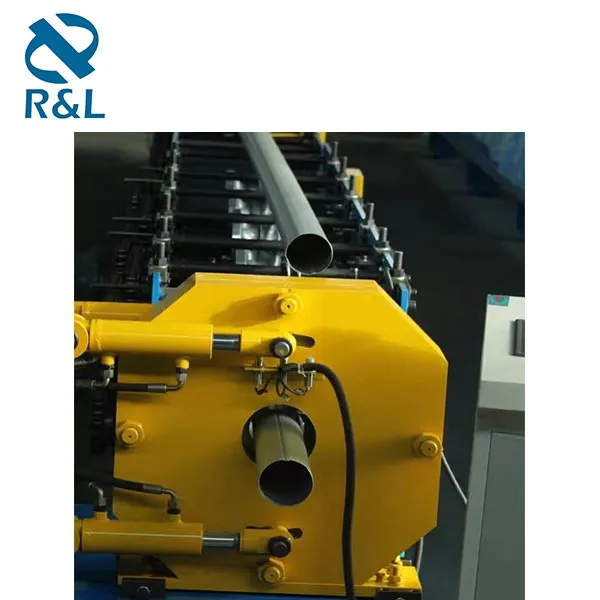
Similarly, in the production of Downspout Pipe Roll Forming Machine, a fast response time is essential for achieving precise length and diameter control. This is crucial for ensuring that the downspout pipes fit correctly during installation and meet the required standards.
Conclusion
In conclusion, the response time of the control system in a steel roll forming machine is a critical factor that affects the machine's performance, accuracy, and efficiency. By understanding the factors that influence response time and implementing strategies to improve it, manufacturers can ensure that their machines produce high-quality steel products consistently.
As a supplier of steel roll forming machines, we are committed to providing our customers with machines that have fast and reliable control systems. Our machines are designed with high-quality hardware, optimized software, and efficient communication protocols to ensure a quick response time. If you're in the market for a steel roll forming machine or have any questions about response time or other aspects of our products, we encourage you to reach out to us for a detailed discussion. We look forward to working with you to meet your production needs.
References
- "Industrial Automation Handbook" by Peter Welter
- "Control Systems Engineering" by Norman S. Nise
- Technical documentation from leading PLC and sensor manufacturers


